
























Running multiple ad campaigns but not seeing results? You are not alone.
Many businesses invest heavily in Google Ads but experience low click-through rates, high cost-per-click, and low return on ad spend.
Without a clear strategy, targeting, and ongoing optimization, Google Ads can quickly become an expensive guessing game.
At Get Reviews Buzz, we specialize in professional Google Ads management that produces results.
We don't just create ads and set budgets; we also align your campaigns with real-world business objectives, eliminate wasteful spending, boost Quality Scores, and convert traffic into measurable conversions.
In this guide, you'll learn about Google Ads management services, how a Google advertising agency drives consistent ROI, common mistakes businesses make when managing ads on their own, and how to select the right partner to help you grow your revenue.
What is Google Ads Management?
Google Ads management is the process of planning, creating, monitoring, and constantly improving your Google advertising campaigns so they generate leads and sales rather than just clicks.
A lot of people think Google Ads management means setting up an ad once and letting it run.
Does Google Ads Management Improve ROI?
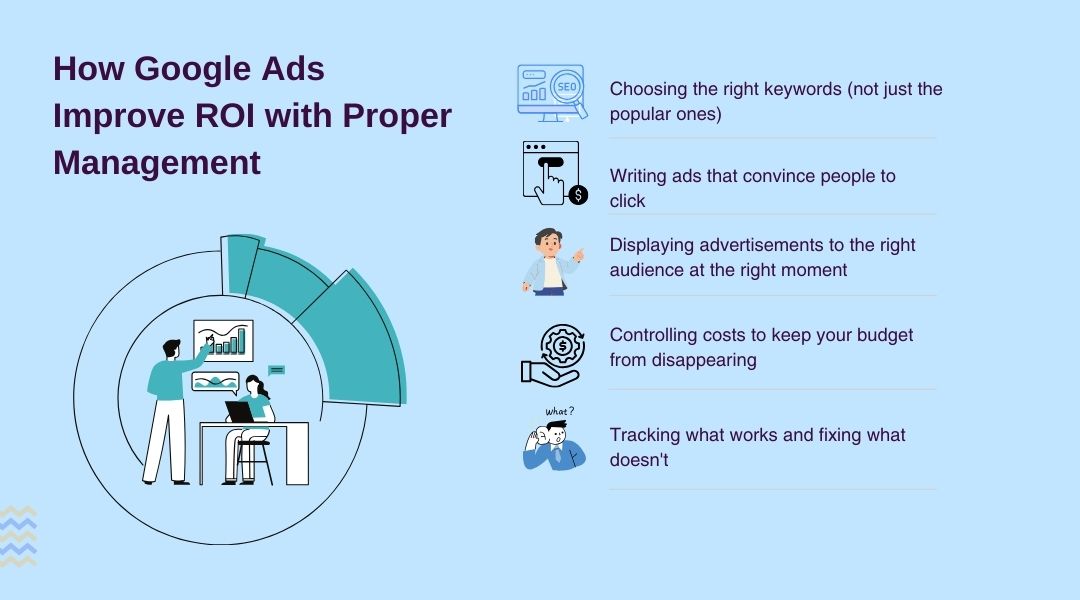
Simply put, Google Ads works on an auction system.
You’re competing with dozens, sometimes hundreds, of other advertisers for the same keywords.
If your ads aren’t relevant, your targeting is off, or your landing page doesn’t convert, Google will charge you more and show your ads less often.
That’s why businesses that “just run ads” usually see poor results.
On the other hand, well-managed Google Ads campaigns:
- Get higher click-through rates
- Pay less per click
- Generate better-quality leads
- Deliver a higher return on ad spend (ROAS)
The difference isn’t luck. It’s management.
Core Components of Google Ads Management Services
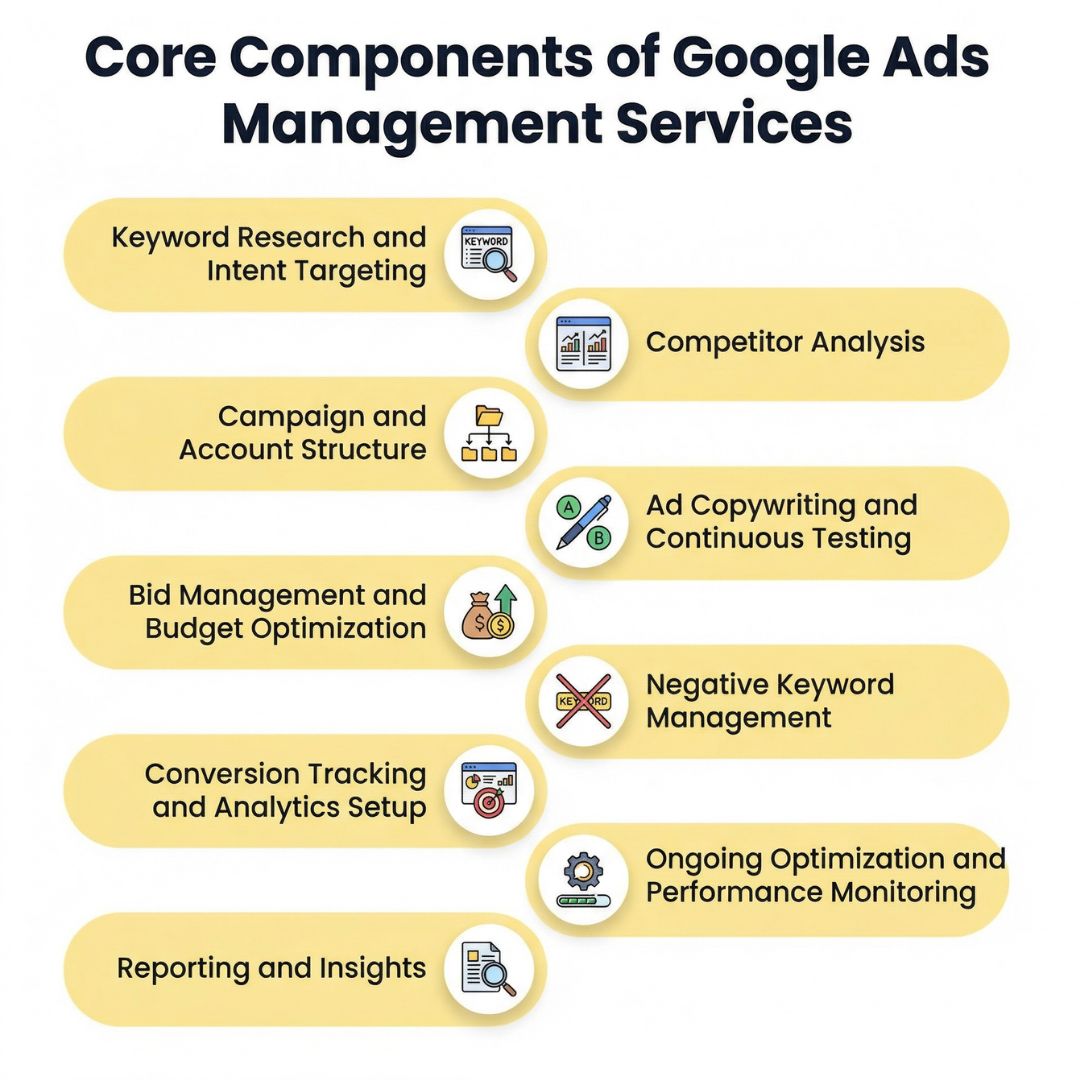
A lot of agencies say they “manage Google Ads,” but what does that actually mean?
Real Google Ads management isn’t just about turning ads on and off.
It’s a combination of strategy, data, testing, and constant improvement. Below are the core components that go into managing Google Ads the right way.
Keyword Research and Intent Targeting
Everything starts with keywords.
But successful Ad management doesn’t mean targeting the most searched keywords.
It means targeting the right keywords, the ones people use when they’re ready to buy, sign up, or contact you.
A proper Google Ads management service focuses on:
- Finding high-intent, money-making keywords
- Avoiding low-quality or irrelevant searches
- Using long-tail keywords to reduce costs
- Grouping keywords based on search intent
The goal is simple: bring in people who are actually looking for what you offer.
Competitor Analysis
Competitor analysis is a critical but often ignored part of effective Google Ads management.
Every keyword you bid on is part of an auction, and your competitors’ bids, ad copy, landing pages, and Quality Scores directly affect how much you pay and how often your ads show.
A professional Google Ads management service includes competitor analysis for:
- Determine which competitors are bidding for the same keywords.
- Analyze competitor ad copy, offers, and extensions.
- Understand the average bid ranges and auction pressures.
- Identify gaps in which competitors are weak or absent.
- Avoid unnecessary bidding wars that drive up costs.
Understanding what competitors are doing enables campaigns to be more strategically positioned, with smarter bids, stronger messaging, and better landing pages to win clicks without overspending.
Competitor analysis helps you compete intelligently, not aggressively.
Campaign and Account Structure
Google Ads performance depends heavily on how your account is structured.
A professional Google advertising agency creates:
- Clean, well-organized campaigns
- Tightly themed ad groups
- Clear separation between services, products, or locations
Why does this matter?
Because better structure leads to higher relevance, better Quality Scores, and lower cost-per-click.
In short, Google rewards well-organized accounts.
Ad Copywriting and Continuous Testing
Even the best keywords won’t work if your ads don’t grab attention.
Google Ads management includes writing clear, persuasive ad copy that:
- Matches what users are searching for
- Highlights real benefits, not just features
- Uses strong calls-to-action
- Speaks directly to the customer’s problem
- And it doesn’t stop there.
Good managers constantly A/B test headlines, descriptions, and offers to find out what actually gets clicks and conversions.
Bid Management and Budget Optimization
This is where many businesses lose money.
Without proper bid control, you can easily overspend without seeing results. Google Ads management services primarily focus on:
- Developing smart bidding strategies.
- Adjusting bids based on performance.
- Reducing wasteful spending on low-quality clicks
- Allocating funds to high-converting campaigns
The goal is straightforward: get the most value out of every dollar you spend.
Negative Keyword Management
This is one of the most overlooked parts of Google Ads.
Negative keywords stop your ads from showing for searches that don’t make sense for your business. Without them, you pay for clicks that will never convert.
A Google Ads management service regularly:
- Reviews search terms reports
- Adds irrelevant searches as negatives
- Protects your budget from wasted clicks
This alone can dramatically improve ROI.
Conversion Tracking and Analytics Setup
If you’re not tracking conversions, you’re guessing.
It ensures:
- Conversion tracking is set up correctly
- Leads, purchases, calls, or sign-ups are measured
- Data is accurate and reliable
This allows managers to see what’s working, what’s not, and where to optimize next.
Ongoing Optimization and Performance Monitoring
Google Ads is not a one-time configuration.
Campaigns necessitate ongoing monitoring and improvement, including:
- Pause ads that aren't performing well.
- Scaling winning campaigns
- Adjusting keywords and bids
- Testing new strategies
Ongoing optimization is what turns an average campaign into a profitable one.
Reporting and Insights
Finally, a good Google Ads management service doesn’t just send reports; it explains them.
You should know:
- Where your money is going
- What results you’re getting
- What changes are being made and why
Clear reporting helps you make smarter business decisions, not just marketing ones.
Common Google Ads Mistakes That Kill Results
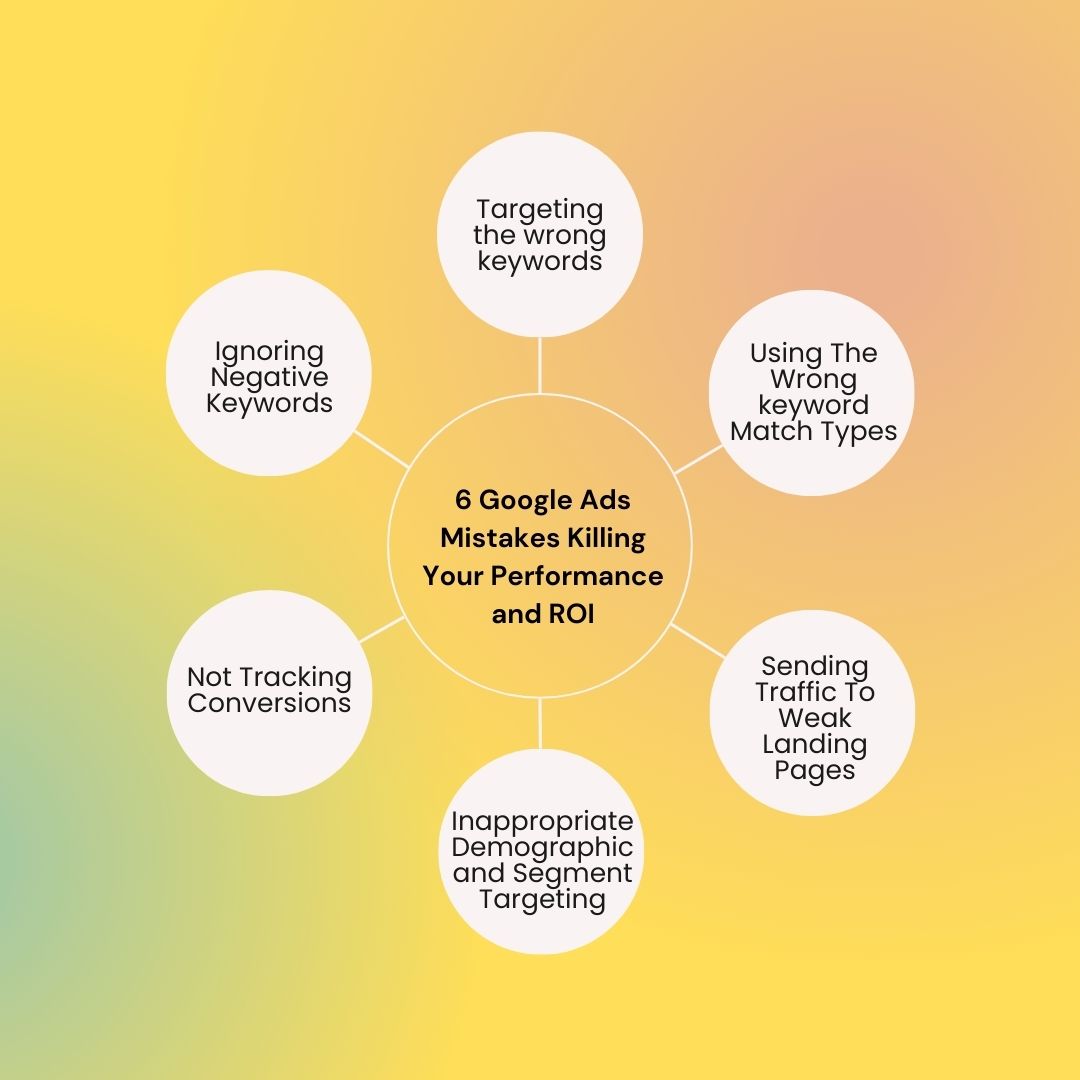
Most Google Ads campaigns don’t fail because Google Ads doesn’t work.
They fail because of small but expensive mistakes that quietly drain the budget.
If your ads are running but results are disappointing, there’s a good chance you’re making one (or more) of these mistakes.
Targeting the Wrong Keywords
This is the most common mistake.
Many businesses target keywords with high search volume, assuming more searches mean more customers. In reality, those keywords are often vague and attract people who aren’t ready to buy.
For example, someone searching “marketing tips” is very different from someone searching “Google Ads management services.”
Good Ad management focuses on intent, not just traffic. The right keywords bring fewer clicks but far better results.
Ignoring Negative Keywords
If you’re not using negative keywords, you’re wasting money.
Negative keywords tell Google when not to show your ads. Without them, your ads can appear for searches that are irrelevant, low-quality, or completely unrelated to your business.
This leads to:
- Unqualified clicks
- Higher costs
- Lower conversion rates
Regular negative keyword cleanup is one of the fastest ways to improve ROI.
Sending Traffic to Weak Landing Pages
Getting clicks is easy. Getting conversions is the hard part.
A common mistake is sending ad traffic to:
- A generic homepage
- A slow-loading page
- A page with no clear call-to-action
Even the best ads won’t convert if the landing page doesn’t match the search intent or clearly explain what to do next.
Strong landing pages turn clicks into leads. Weak ones waste your ad spend.
Using the Wrong Keyword Match Types
Keyword match types control how closely a search must match your keyword.
Many campaigns fail because:
- Broad match is used without control
- Exact match is too limited
- Match types are mixed without strategy
The result? Ads show up for searches you never intended to target.
Proper match type selection helps balance reach, relevance, and cost, which most DIY campaigns overlook.
Not Tracking Conversions
This is similar to driving with your eyes closed.
Without conversion tracking, you don't know.
- Which keywords generate leads
- Which ads really work?
- Where should your budget go?
You may be spending money on campaigns that appear to be successful but do not produce tangible business results.
Accurate conversion tracking is the foundation of effective Google Ads administration.
Inappropriate Demographic and Segment Targeting
Targeting the wrong demographics and audience segments can be a silent budget killer.
Many businesses believe that broader targeting generates more leads. In reality, targeting ads to the wrong age groups, devices, locations, or audience segments results in clicks that do not convert.
Mistakes in demographic targeting include:
- Displaying ads to age groups that rarely convert.
- disregarding device performance differences.
- Selecting locations outside of service areas.
- Excluding underperforming audiences.
- Treating all users equally, regardless of their intent.
When demographic and audience segments are not optimized, Google Ads spend rises while lead quality decreases.
How Get Reviews Buzz Improves Google Ads Campaign Performance
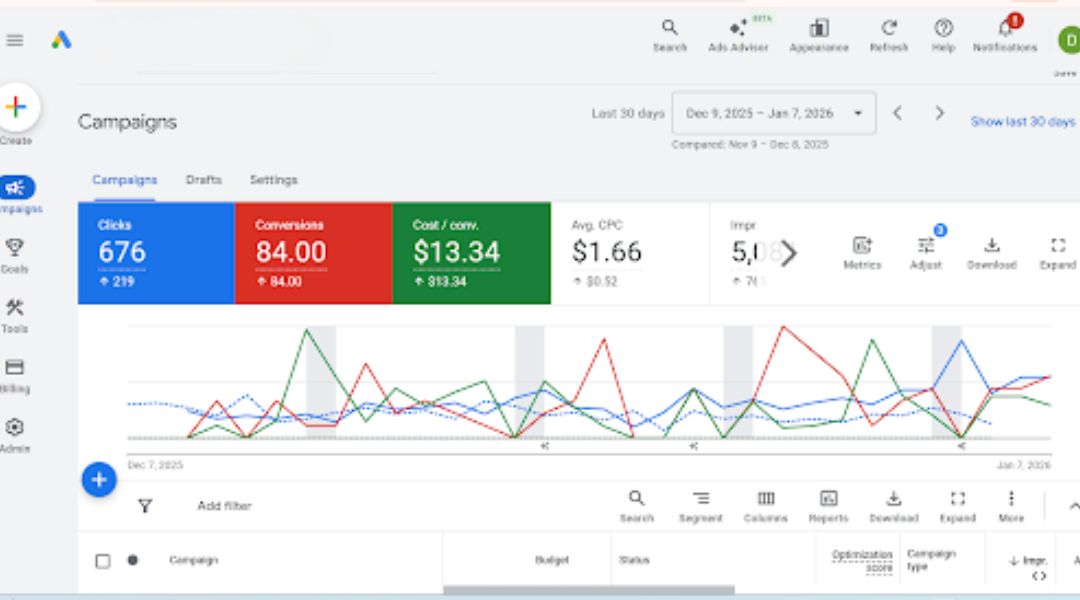
Managing Google Ads is not about guessing. It's about adhering to a clear process and making decisions based on real data. Here's how professional Google Ads management services
improve long-term results.
Step 1: Evaluate Your Current Campaign's Performance
Before making changes, we evaluate your current campaigns to determine what works and what doesn't. Our experts consider five key metrics:
- Impressions are the frequency with which your ad appears. More impressions do not always imply success; relevance is most important.
- Clicks represent how many users interact with your advertisements. Low click-through rates indicate ineffective targeting or ad copy.
- Cost and CPC: Total expenditure and cost per click. The goal is to generate profitable clicks, not cheap ones.
- Conversions: Actions that matter, like form submissions, calls, or purchases.
- Click-Through Rate (CTR): Shows ad relevance. Higher CTR lowers costs and improves ad performance.
- CPL (Cost Per Lead): Along with impressions, clicks, CPC, conversions, and CTR, Cost Per Lead (CPL) is a critical metric that measures the cost of generating a qualified lead.
These insights enable us to identify opportunities, reduce waste, and prioritize high-performing campaigns.
Step 2: Improve Your Targeting
Even the best advertisements fail if they reach the wrong people. We use advanced targeting techniques to reach those who are most likely to convert:
- Demographics: location, age, and device
- Search intent: Users actively seeking your products or services.
- Remarketing refers to past website visitors.
- Custom audiences are based on actual search behavior.
What's the outcome? Ads are only displayed to qualified prospects who are prepared to act.
Step 3: Optimize Ad Copy for Increased Engagement
Strong ad copy drives more clicks and conversions. Our team constantly tests and improves.
- Headlines and descriptions.
- Offers and Promotions
- Calls To Action (CTAs)
We make one change at a time to assess impact, ensuring that your campaigns are constantly improving. Dynamic ads are also being tested to see how well they can automatically match search intent to on-page content.
Step 4: Remove Negative Keywords
Negative keywords keep your ads from appearing in irrelevant searches, saving you money and improving lead quality.
Without regular negative keyword management, your advertisements may appear for:
- Research-only searches
- Low-intent queries
- Unrelated services
To protect your budget, we keep negative keyword lists updated on a regular basis.
Step 5: Optimize Landing Pages for Conversion
Clicks are useful, but conversions are more important. We check your landing pages to ensure that:
- Match the ad message.
- Use clear headlines and persuasive copy.
- Include prominent calls to action.
- Load quickly and seamlessly on mobile devices.
Even minor improvements can significantly increase ROI.
Step 6: Use Smart Bidding Strategies
The right bidding strategy ensures that every ad dollar is used effectively. Depending on your objectives, we select either manual or automated bidding.
- Increase traffic.
- Maximize visibility
- Increase conversions.
- Achieve the targeted ROAS (Return on Ad Spend).
Proper bid management reduces wasteful spending while scaling high-performing campaigns efficiently.
Step 7: Continuous Monitoring and Optimization
Google Ads is not a set-and-forget platform. Our team constantly evaluates performance and makes changes to:
- Pause low-performing ads.
- Scale winning campaigns.
- Adjust the keywords and bids.
- Test new strategies.
Ongoing optimization ensures that your campaigns are profitable and in line with business objectives.
Conclusion
Running Google Ads without a strategy can quickly become expensive and ineffective.
Every step is important, from choosing the right keywords and writing persuasive ad copy to optimizing landing pages and monitoring performance.
At Get Reviews Buzz, we combine expertise, continuous optimization, and tried-and-true strategies to ensure that your advertising dollars produce real results.
Do not waste any more money on ineffective campaigns.
Partner with Get Reviews Buzz today to turn your Google Ads into a reliable source of revenue for your company.
FAQs
What are Google Ads management services?
Google Ads management services involve planning, creating, monitoring, and optimizing your Google ad campaigns. The goal is to generate leads and sales, not just clicks, by improving targeting, ad copy, bidding, and conversions.
Why should I hire a Google Ads agency instead of managing my own ads?
Managing Google Ads effectively requires expertise, ongoing optimization, and time. A professional agency, like us, will help you:
- Avoid common mistakes that waste advertising dollars.
- Use high-intent keywords to reach the right people.
- Continuously test and optimize ads to improve ROI.
How much does Google Ad Management cost?
Costs differ depending on the size of your campaigns, industry, and goals. Get Reviews Buzz works with businesses of all sizes to create custom pricing plans that fit your budget while maximizing your return on advertising investment.
How long does it take to get results from Google Ads?
While some results, such as clicks, are immediate, calculating measurable ROI may take several weeks as campaigns are optimized. Our step-by-step approach ensures that your campaigns improve over time through data-driven adjustments that maximize results.


.webp )