

























Looking to optimize your website for Google search results? You can write high-quality content, design an intuitive website, and do everything “right” on your web pages, but still feel invisible in Google results.
It’s frustrating.
You keep asking yourself, “What am I missing?” Most of the time, the answer isn’t on your website at all; it’s what’s happening outside of it. That’s where our off-page SEO services quietly do their job.
Indeed, on-page SEO is a great place to start. Optimizing your content, titles, and pages is important. But if that’s all you focus on, you’re only solving half the problem.
To rank higher in search results, Google needs more than just a well-built website.
Search engines like Google want to promote websites they can trust. Sites that people talk about, link to, and recommend.
When other websites mention you, link back to your pages, or even talk about your brand, it sends a strong signal that your site actually provides value.
And this is exactly what off-page SEO is all about.
What is Off-Page SEO, and Why is It Important?
Consider off-page SEO to be an extension of your online reputation. It's what other websites, people, and platforms say about you when you're not present.
When trustworthy websites link to you, mention your brand, or discuss your content, Google takes notice. Not because you told Google you were fine, but because someone else did.
And those opinions matter far more than self-promotion ever will.
Most guides do not clearly state this, but Get Reviews Buzz does: off-page SEO is not about chasing random backlinks or spamming your site everywhere.
It is all about gradually and naturally developing trust. It is about demonstrating to search engines that real people find your website useful, shareable, and recommendable.
As a result, rankings improve almost unintentionally.
So if you’ve already worked on your content and your website looks good, but traffic still feels stuck, you’re in the right place.
In this guide, we’ll walk through off-page SEO clearly, simply, and with examples that actually make sense.
On-Page SEO vs. Off-Page SEO: A Quick Look
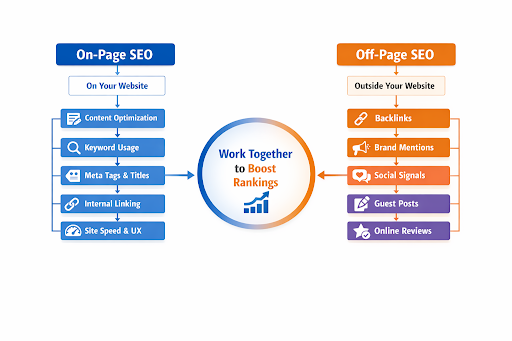
On-page SEO and off-page SEO are two sides of the same coin. They both matter, and neither functions well without the other.
On-page SEO refers to everything that you can control on your own website. This includes your content, page titles, headings, images, internal links, and overall site layout.
It is important to ensure that your website is clear, useful, and understandable to both users and search engines.
In layman's terms, on-page SEO helps Google determine what your website is about.
In contrast, off-page SEO takes place outside of your website. It is about how the rest of the internet perceives you.
This includes links from other websites, brand mentions, reviews, and even online discussions about your company.
Off-page SEO helps Google decide whether your website can be trusted.
Here’s the key difference:
- On-page SEO tells Google what you do
- Off-page SEO shows Google that others trust you
And, you need both.
A website with great content but no off-page signals looks unproven. And a site with lots of links but poor content won’t hold its rankings for long.
When on-page and off-page SEO work together, that’s when real, long-term results start to show.
Key Off-Page SEO Factors That Actually Matter
When people talk about off-page SEO, a lot of things get mixed together. Backlinks, mentions, reviews, and social media, it can feel overwhelming pretty quickly.
But the truth is, not everything outside your website carries the same weight.
As an off-page SEO services company, we understand that Off-page SEO works when the focus is on trust, relevance, and real value.
Search engines are trying to understand how your website is viewed across the internet, not how many links you can collect.
Here are the key off-page SEO factors that actually make a difference:
Quality Backlinks
Links from trustworthy, well-established websites are one of the strongest off-page signals. A few high-quality backlinks from relevant sites are far more powerful than dozens of low-quality ones.
Relevance of Linking Sites
Where a link comes from matters just as much as the link itself. When websites in your niche or industry mention you, search engines recognize that your content is well-suited to that environment.
Brand Mentions
Even if a website mentions your brand but does not link to it, it helps to increase credibility. These mentions show that people are talking about your company beyond its website.
Website Authority and Trust
Search engines evaluate the overall authority of websites that link to or mention you. Links from reputable sources are more credible and contribute to your site's reputation.
User Engagement and Real Traffic
Websites with active users, genuine engagement, and consistent traffic send stronger signals than empty or inactive ones. Off-page SEO is most effective when it connects you with real audiences.
Online Reviews & Reputation
Reviews play an important role in building trust. Positive reviews across multiple platforms demonstrate to users and search engines that your company is trustworthy and worth recommending.
Finally, off-page SEO is not about chasing numbers. It is about creating a strong online presence that search engines can rely on.
Off-page SEO Strategies That Really Work
Off-page SEO does not entail implementing everything everywhere. It is about deciding which strategies are best for your company, competition, and goals.
Here are some of the off-page SEO strategies we employ to establish true authority and long-term rankings:
Link Building
Getting backlinks from credible, trustworthy websites is a vote of confidence for your site. When quality sites link to you, search engines see your content as valuable and trustworthy, which boosts your rankings.
Guest Posting and Thought Leadership
Publishing articles on relevant websites helps in two ways. It increases backlinks and positions your brand as an industry expert. These links may not always generate a lot of traffic, but they help to build trust and authority over time.
Business Citations
Citations list your company's name, address, and phone number (NAP) in reputable directories. They help search engines confirm that your business is real, consistent, and active, which is especially important for local SEO.
Online Reviews
Not only do reviews influence customers, but they also influence search engines. Positive 5-star reviews indicate credibility, build trust, and may even help your business appear in more search results.
Content Marketing
Backlinks naturally gravitate toward high-quality content. When people find your content useful, they are more likely to share or refer to it on their own websites and social media accounts.
Influencer Outreach
Collaborating with influencers can help your brand reach new audiences. It also increases credibility, which often results in brand mentions and backlinks from credible sources.
Forums and Community Platforms
Participating in platforms like Reddit and Quora boosts brand awareness and trust. These areas also reveal important information about what your target audience is looking for.
Social Media Promotion
Social media links may not directly improve rankings, but they do increase visibility. More people who see your content are more likely to share it, mention it, and link to it naturally.
Podcast Appearances
Being featured on podcasts helps to establish your brand's authority. It also fosters trust among new audiences, which can result in valuable brand mentions and links.
Off-Page SEO Checklist: How We Build Links the Correct Way
As a reputable off-page SEO agency in India, we recognized that not all backlinks are beneficial to your website.
Some increase rankings and trust over time, while others do nothing or, worse, cause problems later.
That is why off-page SEO should never consist solely of link building. Before we use any off-page SEO tactic, we go through a simple checklist to ensure that each link is worthwhile and safe in the long run.
Here's what we consider before creating any link:
Domain Authority and Page Authority
We assess both the overall strength of the website and the specific page where the link will appear. Strong authority indicates that the link has more value.
Dofollow Links
Dofollow links pass SEO value to your website. While nofollow links have their place, dofollow links remain important for rankings.
Real Traffic on the Website
A website should have real visitors. If a site has no traffic, even a high DA number doesn’t mean much.
Low Spam Score
We avoid websites with high spam scores or strange link patterns. Long-term SEO success is dependent on having clean link profiles.
Relevance to Specific Niche
Links from websites related to your industry or topic are most effective. Relevance almost always beats volume.
High-Value Content
Every link should sit inside content that actually helps readers. Thin, low-quality content is something we stay away from.
Competitor Backlink Analysis
We look at where competitors get their links from. This helps you identify opportunities that have previously proven to be successful in your niche.
This checklist ensures that off-page SEO prioritizes quality, relevance, and trust over short-term shortcuts.
Common Off-Page SEO Mistakes to Avoid
The following are some common off-page SEO mistakes to avoid.
Focusing on Quantity over Quality
Having hundreds of backlinks may appear impressive, but if they come from low-quality or unrelated websites, they will be useless. In some cases, they can harm your website. A few relevant, trustworthy links always take precedence over a large number of ineffective ones.
Ignoring Relevance
Backlinks from random websites unrelated to your niche do not convey a strong message to search engines. Off-page SEO works best when links and mentions come from websites related to your industry or topic.
Using Spammy or Automatic Link Building
Quick link-building tools and automated methods may promise fast results, but they usually result in low-quality links. These shortcuts are rarely effective in the long run and can lead to problems later.
Overlooking Brand Mentions
Many people only consider backlinks and ignore brand mentions. However, even unlinked mentions help to increase trust and visibility. Off-page SEO focuses on presence rather than links.
Depending on Only One Strategy
Relying solely on guest posts or directories limits your potential growth. A healthy off-page SEO strategy combines backlinks, content promotion, reviews, and brand visibility.
Expecting Instant Results
Off-page SEO requires time. If results do not appear immediately, this does not imply that it is not working. Building trust and authority on the web is a gradual process.
Frequently Asked Questions
What is the definition of off-page SEO in simple terms?
Off-page SEO is everything that happens outside of your website to help it rank higher in search engines. This includes backlinks, brand mentions, reviews, and how people discuss your website on the internet.
Is off-page SEO still important in Google rankings?
Yes, very much. Off-page SEO helps Google determine whether your website can be trusted, whereas on-page SEO helps Google understand your content. Both work together to improve rankings.
Are backlinks the only part of off-page SEO?
No. Backlinks are important, but off-page SEO also includes brand mentions, reviews, citations, social visibility, and overall online reputation. All of these signals help build trust.
How long does off-page SEO take to show results?
Off-page SEO requires time. You may notice small improvements in a few weeks, but strong and consistent results typically take several months. This is a long-term strategy, not a quick fix.
Can bad backlinks harm my site?
Yes. Links from spammy, irrelevant, or low-quality websites can harm your site rather than help it. That is why prioritizing quality and relevance is so important.
How can I tell if an off-page SEO strategy is safe?
A safe off-page SEO strategy prioritizes credible websites, relevant content, genuine traffic, and organic link building. If something appears rushed, automated, or too good to be true, it probably is.
Conclusion
Off-page SEO does not involve taking shortcuts or chasing numbers. It's all about establishing trust, which search engines and real people value.
When other websites link to you, mention your brand, or recommend your content, it sends a strong message about the value of your website. That is exactly what search engines aim to reward.
Off-page SEO becomes less confusing and far more effective when you prioritize quality backlinks, relevant platforms, strong content, and a clean online reputation. When combined with effective on-page SEO, it allows your website to grow steadily and rank confidently over time.
In the end, off-page SEO is simply about establishing credibility across the web, which no algorithm update can diminish.


.webp )